
Zsigmond Máriás, CEO, IT development specialist
May 4, 2026 · Ecommerce, Integration
Franchise eCommerce Platforms: 5 Strategic Marketplace Models
Franchise networks operating without online sales fall behind their competitors. While independent retailers face straightforward decisions, integrating dozens or hundreds of franchise partners into e-commerce presents complex challenges. The franchise model relies on independent business owners selling under shared branding with a unified product range. That works geographically offline, but it collapses online, where geographic boundaries disappear — multiple partners running separate webshops under the same logo fragments the brand instead of strengthening it.
Five Models at a Glance
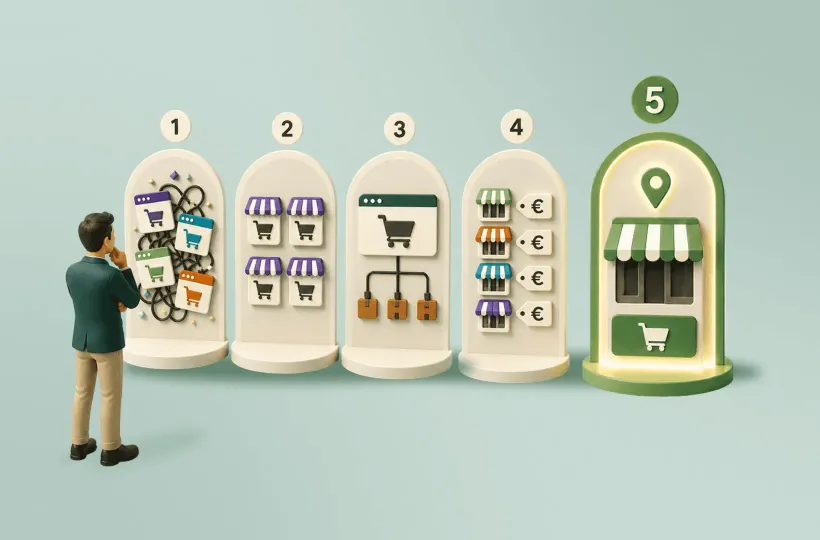
Franchise networks typically choose between five structural approaches, each trading off partner freedom, brand consistency, and cost differently:
- Independent online stores — each partner builds its own webshop; maximum freedom, but a fragmented brand experience and partners bidding against each other on ads.
- Unified eCommerce template — headquarters provides a shared template or subdomain setup; consistent look and lower per-partner cost, but 50+ separate domains still compete in search.
- Centralized eCommerce platform — one webshop, orders routed to partners by headquarters; full brand control, but order allocation and revenue-sharing become politically contentious.
- Traditional marketplace — all partners sell side by side, customers pick one, like Amazon; concentrates marketing spend but triggers price wars between partners and confusing multi-package deliveries. Almost never the right fit for a franchise network.
- Franchise marketplace platform — customers first pick (or are geolocated to) a partner, then shop that partner's store with one cart and one checkout, modeled on Wolt or DoorDash.
The Franchise Marketplace Model
The franchise marketplace model is the one built specifically for this problem. A geolocation-based partner selector detects the customer's location (browser geolocation or zip code), matches it against each partner's defined delivery zone, and falls back to the next available partner when inventory runs out — with in-store pickup working as a store locator. The result is one brand, one platform, one marketing budget: no partner cannibalizes another on price or search rank, new partners onboard in days rather than months, and headquarters keeps central quality and compliance control. The trade-off is architectural complexity — this needs genuine multi-tenant design, which standard platforms like Shopify, WooCommerce, or Magento don't support out of the box, so it calls for an experienced technology partner rather than an off-the-shelf install.
Conclusion
For most franchise networks, the franchise marketplace model offers the best balance: headquarters gets a unified brand, central control, lower per-unit cost, and consistent legal compliance; partners keep their business autonomy without having to build or fund their own webshop; and customers get the simple, familiar experience they already know from food-delivery apps. Getting there takes a technology partner experienced with multi-tenant architecture, geolocation-based partner selection, delivery zones, and partner onboarding — not a generic e-commerce build.